by Tim Kirchoff
At some point in 2015 or early 2016, I noticed that the prayers of the faithful at my home parish often included an intention regarding "just and comprehensive immigration reform." Not merciful, but just. The prayer was not that people who try to come to America be treated mercifully, but that they be treated justly.
On its surface, a prayer for "justice" in immigration laws seems like something that one might hear from people who favor stricter enforcement of our immigration laws, but it takes on a different meaning when it comes from people who sympathize deeply with the concerns and interests of the undocumented. Justice, they seem to say, is better than what the undocumented are subjected to under the existing legal regime.
Curious, I began to look for prayers about immigration from the pro-enforcement side. But at the time, the only prayers I could readily find that seemed related to the immigration issue but were not in favor of the immigrants themselves were aimed toward ensuring the safety and success of law enforcement in border regions, and to the extent that the prayers were directed against anyone, it was against drug traffickers.
I no longer have the resolve to spend any length of time researching what sorts of prayers immigration hawks might be offering in the age of Trump, but at the time, it struck me that it would be rather difficult for anyone to pray that all the undocumented be deported. By the same token, one could hardly pray that the individuals, families and communities that are affected by deportation or the ever-present fear of deportation continue to suffer in those ways.
My point is not that some immigration hawks know deep down that the policies they defend are not just in God's eyes. OK, well, maybe it is, but only tangentially. More basically, I think the prayers offered by both sides are actually compatible. Most advocates for immigrants and refugees would happily pray for the safety and success of border enforcement agents in apprehending drug traffickers and dangerous criminals, and I suspect that those who pray for border patrol agents would also be willing to pray that our country institute and enforce immigration policies that are in accordance with justice.
Such shared prayer may be helpful in finding ways for different sides to agree with minimal equivocation, and this in turn might help rebuild a shared recognition of the goods we hold in common. In trying to pray together, we are not only trying to invite the "other side" into our words and concerns, but to bring both sides' concerns before God. Each side must not only concede that the other side has something of value that they are trying to protect, and then further surrender the question to God.
That process is, in theory, what legislative chaplains are supposed to facilitate, and why the story about Paul Ryan pressuring the House chaplain to resign was so fascinating to watch. At first, the story was that Fr. Pat Conroy was being fired because of overly partisan prayers; the narrative later changed to Republican dissatisfaction over the pastoral care he was offering.
In the first narrative, a prayer before a debate on the Republican tax bill was supposedly read as being critical of the bill's intentions. If indeed Republicans took umbrage at the chaplain praying that they, '"be mindful that the institutions and structures of our great nation guarantee the opportunities that have allowed some to achieve great success, while others continue to struggle” and that they “guarantee that there are not winners and losers under new tax laws, but benefits balanced and shared by all Americans,”' then it would seem to be a case of, to borrow Shakespeare's phrase, protesting too much. If a prayer that the lawmaking process serves the common good (and especially the poor) strikes you as a jab against your intentions despite the fact that your allies frequently invoke those same ideas in support of the legislation, then perhaps your own intentions are not so good.
A well-composed prayer in the context of a political debate is a challenge; it cannot be merely perfunctory or platitudinous, or it accomplishes nothing. Nor can it be partisan, or it only makes the debate more acrimonious: when the person praying forgets that God is the intended audience, and instead tries to use religious language to partisan ends, then they're not praying so much as cheerleading.
At its best, prayer is the necessary starting point for a shared process of policy discernment. If the prayer contains conscious equivocation-- for example, in abortion debates, both sides claim to represent human rights-- then treating each side's concern as sincere and not just political posturing is a necessary precondition for resolving the tension.
Prayer gives us an opportunity to engage our consciences. It is a way of asking ourselves whether what we are trying to accomplish is truly in line with what we believe to be morally correct, and of recognizing that people who disagree with us may nonetheless be acting in good faith.
In short, finding ways to pray together about politics is an interesting challenge. Let's try it more often.
Showing posts with label TRH on prayer. Show all posts
Showing posts with label TRH on prayer. Show all posts
Monday, June 3, 2019


Monday, May 20, 2019
TRH on Prayer No. 2: The 'Yes' May Never Come
by Laura Flanagan
What does it mean to pray really hard for something to which you may not ever hear “yes”?
Does that mean you’re praying for the wrong thing? Not necessarily. There are infinite paths to sainthood. There are multiple ways to follow Christ. It’s okay to prefer one path and ask for it. You just may not be given it. What then?
Here, I decided to number the steps I’ve gone through so far in that process, this hashing out of things with God. It’s a particular struggle that a lot of people face, and face for far longer than I have. (Editor's Note: Here's a previous reflection on her family from Laura.)
1. Pray for another child in your family, and not receive what you asked for.
2. Pray, and not receive again.
3. Feel like your body isn’t done with this work, and express that to God.
4. Not receive again.
5. Realize that this disappointment may continue for a long time, or may continue forever - so how do you keep this from becoming a disappointment in God? Or too painful, where you lose hope?
I knew I had to balance this with the hope that such joy might be. Our Lord always wants us to have hope. But it certainly feels more like “getting my hopes up,” leading to more intense disappointment or sorrow.
Gratitude is the key there, I tell myself. If we do not expect specific good things, we are more grateful when they make their appearance. And if we are grateful for both expected and unexpected joys, we are less likely to expect specific ones.
5.1 Strongly resist any temptation to feel like God owes you this.
Related to the above - this feels like progress from #5, but really isn’t. I was pretty confident that I didn’t feel like God owed me a “yes” to this intention. “I’ll love you, regardless, Lord, sure.” But I did feel a little bit like he owes my daughter. That’s the tough part of intercessory prayer - prayer for others. You’re not asking for good things for yourself, but for others. You’re turned outward, as you should be, instead of inward, solely focused your own needs and wants. And yet the answer may not be yes to others’ wants either, no matter how deserving they are.
That “little bit” of feeling Clare’s owed a sibling is probably just about me. I’m resisting the seemingly more difficult path of forming a child who doesn’t have the gift of siblings. I am not perfect, so to be responsible for a third of the love and witness she’s supposed to receive from her immediately family certainly makes me think that it would be better to have more family members to love her. And maybe it would be better - but “good enough” is enough for the Lord to work with in her heart and soul.
6. Consider whether God is calling you to foster care.
7. Discern “no” on the foster care question, and be pretty sure that answer is not subconsciously yours because you selfishly don’t want to do it. You actually kind of do want to do it - but recognize that it would not be best for you, for your family... right now.
8. Start figuring out that the only profitable thing to ask for is “better conformity to the will of God,” since you were investigating the will of God with the foster care thing.
All prayer should have the caveat, implicit or explicit - "but not my will, but yours be done.” Then we also have to mean it. We do not know how to pray as we ought, we may not know if we're praying for the exact right thing, but if we're open, the Holy Spirit can intercede for us in the appropriate way, and make us willing to accept what God does intend to give.
It can be terribly hard to mean it. The spirit is willing, but the flesh is weak - and “flesh” here can be your emotions, your mental state. You may know what the peace-filled, surrendering-to-God attitude would be in a situation, but you just can’t quite muster it. Sometimes you’re just angry or upset that you don’t have what you want. Sometimes you do just feel like God should give it to you.
9. Still cry out to God every so often.
This has a great precedent in the Psalms, which everyone should read and pray. Jesus quoted Psalm 22’s “My God, my God, why have you forsaken me?” from the cross, after all. When you're just telling the Lord that you miss your daughter, or that you wish your family were larger, all that is is bringing him into that sorrow. You’re already feeling the sorrow, and He's already there anyway - you're just consciously letting Him in.
Samwise Gamgee, stalwart companion to the Ringbearer in the Lord of the Rings trilogy, upon seeing the resurrected wizard Gandalf again, says, “Is everything sad going to come untrue? What’s happened to the world?” An Easter morning statement if there ever was one.
Everything sad will come untrue, indeed. But that doesn’t always change that it’s sad now, and there’s no guilt or shame to be found in that. “My son was dead, and is alive again,” as the father in the parable of the Prodigal Son explains. The son had been "dead." The father had sorrowed over that. He had prayed that the son might return - but didn’t have control over whether he would. That control belonged elsewhere.
Even if the Father is God and not a human father, as the parable intends, God too has placed himself in that humble, uncontrolling position through his gift of human freedom. He both wants for us life in abundance, and cannot not always prevent ill - that gift and that consequence are partnered until the eschaton.
The first of the “Eleven Addresses to the Lord” by poet John Berryman begins with gratitude for the wonder of creation, then continues,
I recommend reading the rest of the poem. Near the end of this address, he allows for the possibility of great miracles, in which he solidly believes. The examples are those times when the risen Lord appeared to Peter and Paul, but Berryman considers those miracles to be perhaps a “special case to establish their initiatory faith.”
Not all of us can receive the special case.
So we have to return to “Thy will be done,” or the succinct prayer of Dag Hammarskjöld: “For all that has been — Thanks. For all that shall be — Yes.”
What does it mean to pray really hard for something to which you may not ever hear “yes”?
Does that mean you’re praying for the wrong thing? Not necessarily. There are infinite paths to sainthood. There are multiple ways to follow Christ. It’s okay to prefer one path and ask for it. You just may not be given it. What then?
Here, I decided to number the steps I’ve gone through so far in that process, this hashing out of things with God. It’s a particular struggle that a lot of people face, and face for far longer than I have. (Editor's Note: Here's a previous reflection on her family from Laura.)
1. Pray for another child in your family, and not receive what you asked for.
2. Pray, and not receive again.
3. Feel like your body isn’t done with this work, and express that to God.
4. Not receive again.
5. Realize that this disappointment may continue for a long time, or may continue forever - so how do you keep this from becoming a disappointment in God? Or too painful, where you lose hope?
I knew I had to balance this with the hope that such joy might be. Our Lord always wants us to have hope. But it certainly feels more like “getting my hopes up,” leading to more intense disappointment or sorrow.
Gratitude is the key there, I tell myself. If we do not expect specific good things, we are more grateful when they make their appearance. And if we are grateful for both expected and unexpected joys, we are less likely to expect specific ones.
5.1 Strongly resist any temptation to feel like God owes you this.
Related to the above - this feels like progress from #5, but really isn’t. I was pretty confident that I didn’t feel like God owed me a “yes” to this intention. “I’ll love you, regardless, Lord, sure.” But I did feel a little bit like he owes my daughter. That’s the tough part of intercessory prayer - prayer for others. You’re not asking for good things for yourself, but for others. You’re turned outward, as you should be, instead of inward, solely focused your own needs and wants. And yet the answer may not be yes to others’ wants either, no matter how deserving they are.
That “little bit” of feeling Clare’s owed a sibling is probably just about me. I’m resisting the seemingly more difficult path of forming a child who doesn’t have the gift of siblings. I am not perfect, so to be responsible for a third of the love and witness she’s supposed to receive from her immediately family certainly makes me think that it would be better to have more family members to love her. And maybe it would be better - but “good enough” is enough for the Lord to work with in her heart and soul.
6. Consider whether God is calling you to foster care.
7. Discern “no” on the foster care question, and be pretty sure that answer is not subconsciously yours because you selfishly don’t want to do it. You actually kind of do want to do it - but recognize that it would not be best for you, for your family... right now.
8. Start figuring out that the only profitable thing to ask for is “better conformity to the will of God,” since you were investigating the will of God with the foster care thing.
All prayer should have the caveat, implicit or explicit - "but not my will, but yours be done.” Then we also have to mean it. We do not know how to pray as we ought, we may not know if we're praying for the exact right thing, but if we're open, the Holy Spirit can intercede for us in the appropriate way, and make us willing to accept what God does intend to give.
It can be terribly hard to mean it. The spirit is willing, but the flesh is weak - and “flesh” here can be your emotions, your mental state. You may know what the peace-filled, surrendering-to-God attitude would be in a situation, but you just can’t quite muster it. Sometimes you’re just angry or upset that you don’t have what you want. Sometimes you do just feel like God should give it to you.
9. Still cry out to God every so often.
This has a great precedent in the Psalms, which everyone should read and pray. Jesus quoted Psalm 22’s “My God, my God, why have you forsaken me?” from the cross, after all. When you're just telling the Lord that you miss your daughter, or that you wish your family were larger, all that is is bringing him into that sorrow. You’re already feeling the sorrow, and He's already there anyway - you're just consciously letting Him in.
Samwise Gamgee, stalwart companion to the Ringbearer in the Lord of the Rings trilogy, upon seeing the resurrected wizard Gandalf again, says, “Is everything sad going to come untrue? What’s happened to the world?” An Easter morning statement if there ever was one.
Everything sad will come untrue, indeed. But that doesn’t always change that it’s sad now, and there’s no guilt or shame to be found in that. “My son was dead, and is alive again,” as the father in the parable of the Prodigal Son explains. The son had been "dead." The father had sorrowed over that. He had prayed that the son might return - but didn’t have control over whether he would. That control belonged elsewhere.
Even if the Father is God and not a human father, as the parable intends, God too has placed himself in that humble, uncontrolling position through his gift of human freedom. He both wants for us life in abundance, and cannot not always prevent ill - that gift and that consequence are partnered until the eschaton.
The first of the “Eleven Addresses to the Lord” by poet John Berryman begins with gratitude for the wonder of creation, then continues,
I have made up a morning prayer to you“According to Thy will” I must learn to begin, always.
containing with precision everything that most matters.
“According to Thy will” the thing begins.
It took me off & on two days. It does not aim at eloquence.
I recommend reading the rest of the poem. Near the end of this address, he allows for the possibility of great miracles, in which he solidly believes. The examples are those times when the risen Lord appeared to Peter and Paul, but Berryman considers those miracles to be perhaps a “special case to establish their initiatory faith.”
Not all of us can receive the special case.
So we have to return to “Thy will be done,” or the succinct prayer of Dag Hammarskjöld: “For all that has been — Thanks. For all that shall be — Yes.”
Monday, May 13, 2019
TRH on Prayer No. 1: Intercessors & the Third Seat at the Table
by Dan Masterton
I remember in college overhearing bits of one of “those conversations,” one of those times someone had done a reading for class that tickled them just so, where a professor had made a comment that agitated them just right, where something about the intellectual gears of college were clicking to spur some big thinking. This friend was remarking to another person, “Did you realize that our prayer isn’t to change God’s mind but to help us change ours?” I wasn’t party to the rest of the conversation, but the essential question was enough to whet my appetite.
That sort of realization makes sense, as I think a natural way to conceptualize prayer, at least as one grows up and first learns their faith, is as a list of requests one makes of God. After memorizing my basic prayers as a little guy, the first insight on prayer I remember learning was from my 2nd grade teacher, Mrs. Johnson, who prepared me for First Communion. She taught us that, after we received communion, it was good to follow up with prayer. Her recommendation was to “thank and ask” -- share one thing with God for which you’re grateful and ask God for think you need. In retrospect, some solid foundational prayer habits to teach eight-year-olds, let alone an adult!
Branching out a bit, theology and catechesis teach us that there’s four basic areas of prayer: praise of God, petition (what we need), intercession (what others need), and thanksgiving. Hopefully, as one’s faith life widens and deepens, one gets exposed to various mediums of prayer, too: sacred music, Taize prayer, centering prayer, contemplative prayer, the Liturgy of the Hours, Eucharistic Adoration, interfaith and ecumenical prayer and prayer services, the Rosary and novenas, and so much more. But even as I grew up and enjoyed the diversity of prayer and liturgical formation, I still don’t think I evolved on my understanding of prayer’s underlying purposes until well after rolling all of these experiences into my spirituality.
One of the major takeaways from my brief foray into spiritual direction during college -- a few years after the aforementioned overheard conversation -- was a bit of a course correction on my attitude toward prayer. First of all, my spiritual director affirmed my desire to pray for loved ones and for their intentions, but he felt my desire to cover those areas so comprehensively was preempting me from going anywhere deeper in my prayer; he suggested that, at least sometimes, I simply take a deep breath and acknowledge that God knows all these intentions in my heart. There’s certainly value in naming these people and intentions, but acknowledging that I was spinning my wheels at times helped focus my prayer time more deeply. Secondly, he encouraged me to focus less on the outline or agenda I carried into prayer and more on making space. Rather than figuring out what I wanted to say to God, I needed to prioritize quieting myself to listen for what God wants to say to me.
These revisions to my prayer discipline helped emphasize the “thy will be done” element of prayer in a new way. Not only do my prayers need to be contextualized in the will of God, but I also need to remix my whole approach such that my priority becomes more specifically listening for what God’s will for me is. I am always struggling to keep this adjusted approach in mind and use it effectively, but the broader impact has stuck with me.
Previously, I came to God trying to share myself. God already knows me and my wants and needs. I almost imagine it like the difference between small-talk and a good, deep, heart-to-heart conversation. God is happy to see me and hear from me, but He doesn’t want to spend most of the time talking about the weather. God wants to shine His light deep into my heart and help me learn the innermost workings of who He made me to be. Not easy, but certainly appealing and inviting!
In my adult life, I’ve found myself gravitating more and more to the lives of the saints. I haven’t gained an encyclopedic knowledge of them or memorized too many feast days. Rather, I’ve organically found attraction and resonance with the witness of the martyrs and their connection to us as friends and intercessors.
While I don’t think we are all called to the crown of martyrdom, I think the essential nature of their lives is their witness. Their ultimate sacrifice of love in Christ came from their fundamental desire and decision to give themselves entirely to God and die to themselves. Saint Oscar Romero discarded his hesitations over stepping on toes and ruffling feathers and instead committed his whole influence and person to the needs of the Salvadoran campesinos, even as it invited inevitable retribution on his life; Saint Maximilian Kolbe held fast to his faith as a terminal prisoner in a concentration camp, diligently working, oversharing his rations with weaker prisoners, and ultimately offering his life for that of another in the ultimate act of charity; Saint Charles Lwanga and his companions clung to their budding faith even as their king became lustful, violent, and capricious, remaining faithful even as they were dragged to the flames of death; Saint Lucy and many other early female saints insisted on their chastity and spiritual prioritization of Christ above any arranged marriages or coercion to become wives to men; and the list can go on and on.
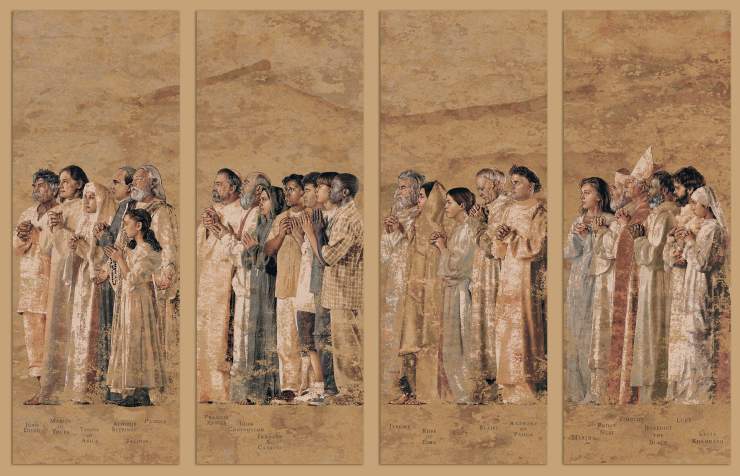 |
| The communion of saints, as depicted in the tapestries at the Los Angeles Cathedral |
While the stories around their deaths, their relics, and their miracles can certainly captivate, it’s the more mundane witness of their living that draws me in. In Oscar, I find a person who realized the need to stop making excuses and compromises that constrained his faith; in Maximilian, I find a person who wouldn’t discard his Christian hope in the face of any threat or mistreatment. It’s that all-encompassing centrality of faith that draws me to them and their intercession. The gritty realities of their life make them accessible, and the grand witness of their faith show us what is possible in ourselves.
So as I think about how prayer isn’t just us trying to ask God to do stuff for us, I imagine my intercessors less as errand-runners carrying messages to God. Instead, I’m growing to see them more as a third person in my conversation of prayer. As I contemplate my lack of patience with my daughter, my frustrations that I don’t have more time to do what I want, my struggles to juggle the various practical and social-emotional needs of my family, who better to join me in my prayer than my martyrs. Oscar, Max, and the bunch gave their lives as witness to the power our love gains when we humbly die to ourselves and live more fully in and for Christ. In prayer, I invite them and their witness close to me so that I can be palpably reminded me not only of the power of humility, of humbly being Christ’s love, but also of its very real and reachable feasibility.
So as I think about how prayer isn’t just us trying to ask God to do stuff for us, I imagine my intercessors less as errand-runners carrying messages to God. Instead, I’m growing to see them more as a third person in my conversation of prayer. As I contemplate my lack of patience with my daughter, my frustrations that I don’t have more time to do what I want, my struggles to juggle the various practical and social-emotional needs of my family, who better to join me in my prayer than my martyrs. Oscar, Max, and the bunch gave their lives as witness to the power our love gains when we humbly die to ourselves and live more fully in and for Christ. In prayer, I invite them and their witness close to me so that I can be palpably reminded me not only of the power of humility, of humbly being Christ’s love, but also of its very real and reachable feasibility.
Subscribe to:
Posts (Atom)
Featured Post
Having a Lucy
by Dan Masterton Every year, a group of my best friends all get together over a vacation. Inevitably, on the last night that we’re all toge...

-
by Dan Masterton Picking up my periodic thread on The Simpsons ( click back here to read my series intro and first post ), today I'm ...
-
5 years ago, I interviewed with members of the campus ministry department at a Catholic university. I had been accepted for graduate school,...
-
 by Dan Masterton Over the ten years of our relationship, my wife has had cause to poke fun at me for plenty of reasons. Chief among them ma...
