Tuesday, May 28, 2024

Bigger than Ourselves - Chapter 11: Some Non-Fictions about Writing Fiction

by Dan Masterton

So here we are, at the final chapter of what is (for now at least) my final fiction story. It’s been fun to work through the process and share it, and I’ve definitely learned a few things worth sharing.

The final chapter is a bit of an epilogue, so I let the last bit of the story stand on its audiobook-own. Here’s the reflections from writing these three stories and trying to get them out there a bit:

First, if you’ve ever wondered about creative writing or fiction writing, give NaNoWriMo a shot.

NaNoWriMo is shorthand for National Novel Writing Month. The idea is that someone takes the month of November and attempts to write 50,000 words to tell a story during the 30 days. The specifics can vary from writer to writer, but the purpose is to set a tidy timeframe and a round-numbered quantity and set to it. While the peak of chatter and activity is November (the ideal time if the communal aspect will motivate you), their excellent resources for sketching and structuring a story and for setting yourself up to succeed are pretty evergreen.

In 2020, as we all navigated new waves of mask mandates, closures, and restrictions, and carried such uncertainty and change into the cold and indoor winter months, I decided to take the plunge on this during that November. Spending some September/October moments in brainstorms, outlines, and then intentional resources, I prepped a story and got down to business. I made it through 50,000 words before the end of the month, and spilled over into December with a few more bits. I shelved it for a few months, picked it up back up for review and edits, and decided to semi-publish it.

I took two more swings at writing stories — in 2021 and 2022 — and I ended up with three full-fledged (novice) medium-length works of fiction. It was a lot of fun to set a goal and work to meet it. I personally found the dash of specificity coupled with wide creative latitude was perfect to engage my creative side and send me in the right direction.

With the exception of a rare assignment along the way in high school, college, and grad school, I can’t remember doing much significant creative writing during school. It was fun to bring all these years of education, reading, and writing into a different mode and try to do something meaningful in a new way. You should give it a shot, too!

The audiobook podcasting and reflecting is complete! Things will shift to a more varied slate of reflections, akin to what longtime friends and readers are used to. Subscribe here to get them in your inbox!

Second, I am uncomfortable with self-promotion. I am unskilled at self-promotion. I am frustrated by the seeming necessity of self-promotion.

The darnedest thing about writing is that people will never read anything you write if they don’t know that you wrote it. If I could will it, I would love to get everything I write in front of a perfect target audience without my ever having directly personally suggested it to any members of that audience. Unfortunately, it takes the writer doing that on their own behalf or laboriously building an audience of people to be that extension; even with an agent or publisher, an author still needs to be committed to doing this big in order to supercharge the reach. I don’t have the stomach for it.

I enjoy small-stakes moments in which I might allude to something I’ve written or published. But, despite whatever arrogance and self-assuredness I possess, I’ve never liked the idea of doing much more than passive posts on social media. I even discontinued the Facebook Page I had going for many years because it just felt too much like an imposition and overkill, especially when I would re-share those posts to my own profile.

When I got these stories together into a larger book, I took one last good try at this process. I picked out some folks who do great work spotlighting things akin to what I do, and I connected with them over sharing these stories. My hope was that my casting a narrow, intentional net, that I could connect with the right audience, seek those connections in an authentic way, and then share myself and my work in a way that felt comfortable.

I was able to join one podcast, one article Q&A, and one web video series, and I am grateful to Jim, Robert, and Amy for their great work and their partnership in spreading the word in this way. Ultimately, these opportunities did not convert to massive book sales, but I am glad to have had the opportunity and appreciate getting those thoughts out to people who may have listened, read, or watched. If more opportunities come up to do interviews, panels, talks, or articles, I’d enjoy the chance, but my heart isn’t in the pavement-pounding or self-marketing that goes into increasing those opportunities.

Ultimately, it reinforced to me that I’ve always welcomed and embraced the things that come more organically, through my jobs, my friendships, and my professional network of ministry folks, and it also confirmed that I am ineffective, uncomfortable, and uninterested in trying to promote myself. I think there’s a line of questioning that helps me understand this not as self-promotion but more broadly or inclusively as evangelization or ministry or informing people. I struggle to get there.

I’d say it’s part aversion and part inability. And I can live with that. I am comfortable marketing myself for jobs and to get a placement in ministry, and I welcome what comes downstream of that. I know my call is to ministry, through pastoral interactions, through writing, and more, unfolding as it may, without pressing.

Finally, you have to be excited about making something artful, creative, and beautiful for its own sake.

Given the overlapping themes of young adults exploring their lives of faith in the Church, in discernment, and in relationship, I put these three stories together into one book. It was fun to title it (Go Your Way!), make some cover art (my Camino pilgrim’s shell!), and build the little compilation (a nifty navy paperback).
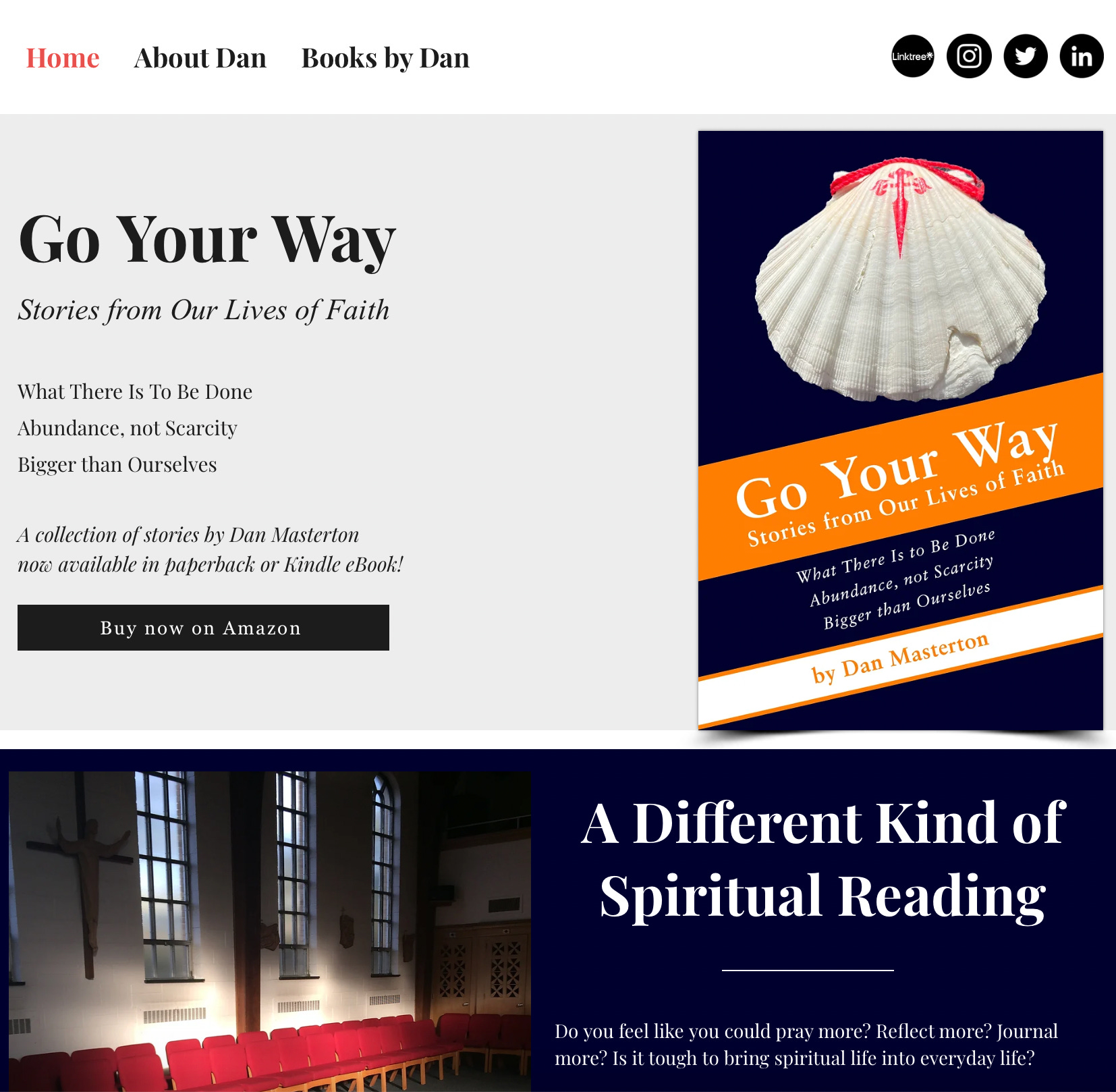
Making this website was fun, too —
almost like writing a cover letter for the public!
Visit bit.ly/booksbydan to browse around.

Even after all that work on the back end plus doing the things I described above to put it out there plus a few bucks in paid advertising, I think I sold about 25 copies of the first story standing on its own and then about 10 copies of the compilation. Eventually, I just lowered the Amazon price to a $0 royalty, and it’s basically listed for cost-of-goods and prints on demand per order. I like this better. I find I actually bring it up more often to others when the financial piece is zeroed out!

This is all to say that, while I would welcome an increased audience if it came, I’ve founded wider, deeper, fuller peace in simply writing — and in the editing, the design, and the process and synthesis — for its own sake. I write because my brain and heart seize upon questions and ideas and hash them out naturally, before I even need to be intentional about it. I write because I want to organize the reflections and synthesize them into something sharper. I write and share because I want to offer my process and result to others and find whether or not it has resonated with them (and this is the little place that drives me to still do this bit of self-promotion I do).

My friend Josh has an even more mature, polished handle on this complex. Put simply, he suggests, “There are precious few external rewards to this craft — writing is an exceptionally inefficient way to gain attention.” He suggests that if you can do an anything else that you just do that. And he’s not wrong.

And I think that’s part of why I can only be a writer as a component and complement to ministry. I can only write when I live out an incarnate faith in my life, in my relationships, in my marriage and family, and in my Church communities, and when I’m striving to be a John-the-Baptist in ministering Christ and the Gospel and our social teaching to others in accompaniment and formation. Doing that ministry and living my life fuel the writing and make it a major-but-not-sole part of who I am and what I do.

Yet, I want to write. I need to write. I want to share. I need to hear what people are reading and what they think of what they’re reading. And all of this happens best when I separate myself from seeking mass appeal or quantified audience or analytical engagement. I’ll never be able to totally avoid the insights data or ignore the quantity of engagement, but I’ll always be delighted to read a comment, hear someone’s response to my offering, or get the chance to have a longer discussion — because I wrote and shared.

Tuesday, May 21, 2024

Bigger than Ourselves: Ch. 10 - A Feasible, Realistic Image of an Ideal Church

 by Dan Masterton

What is your image of the Church?

Sometimes, you can get a sense of someone’s image without even asking them directly. When our lives of faith or our view of the Church come up in conversation, people’s reactions and the places they go organically can often tip this off.

For some people, their response jumps right toward the bishops. As they talk about the way the bishops declare and explain teachings — and in reality, if the bishops spontaneously come up, it’s usually to criticize them — you get a sense of that person’s probably hierarchical image of the Church. For these folks, the Church is its clergy.

Blogs are dying. Emails are proliferating. Why not automatically barrage yourself with another weekly salvo? Enroll in the inanity and insanity here.

In a similar way, sometimes people’s responses focus on the teachings themselves, the dogmas and doctrines and the catechism points and the expectations for Christian living. This image is one of rules and limits, of Church as police state or rulebook.

And sometimes, folks will describe a gathering of people, whether around the altar for a Sunday Mass, banded together for a charity collection drive or service project, or gathered for a social affair. Here, you see an image of community and the life they seek to share.

In truth, our Catholic faith and our Catholic Church is all of these things — we are bishops and clergy and teachings and a Christian lifestyle and a community of believers. And more. Yet, if we find ourselves particularly frustrated or disappointed by our bishops or priests, or we find ourselves particularly frustrated or disappointed by shortcomings in pastorally sharing and learning this faith, we may end up with a limited sense of our Church, and struggle to see past its bishops’ limitations and missteps or its inability to maintain a strong pastoral sense.

I think our faith is strongest, and perhaps most true to Christ and the Gospel, when it begins from a sense of the Body of Christ — that is, both a community of believers gathered in Christ’s name as well as the Eucharist that Christ instituted and gave us a gift to celebrate together and propel us outward to loving action. From there, yes, we turn to our bishops and priests for teaching and leadership, but we ourselves can learn and teach, too. And we look to our Church for a cohesive, coherent transmission of our faith and lifestyle, but we seek to live it out in grace, in accompaniment, and in mutual support and struggle to be all the love God made us to be.

As I go further into adulthood, and meet more and more lapsed or non-practicing Catholics, I count the blessings of having had a moderate and pastorally sound parish to grow up in, of knowing grounded and real religious brothers and priests in the Viatorians and the Congregation of Holy Cross, and of finding parishes as an adult and maintaining relationships where this pastoral, human, joyful community could continue to be found. And I wonder how we can bring more people, especially these Catholics, into positive experiences that might reignite a rogue ember and start a fire of faith in them anew.

In some ways, Bigger than Ourselves is meant to be idealistic, in that it portrays an ultimate hopefulness and good that comes when everything lines up well and people come together in the best ways. Yet, it’s also meant to be a feasible, realistic portrait of Church life and parish life — no one in this story and no behavior in this story in fairy-tale-ish or wildly unlikely. In fact, the people, their ponderings, and their actions all come from real life relationships and experiences I’ve had in my Church life.

I’ve long believed that my best form of evangelization isn’t systematic theology, apologetics, or debate and argument; it’s a life of faith, well lived, often understated but never hidden or diluted. I think the same is true of Church life and parish life — our steady dedication to coming together in Christ as the Body of Christ and responding with individual and communal lives of love and joy can show others the good of this life in Christ. I think this St. Brendan council of young, old, and in between; of lay and ordained; of deep faith and emerging dedication — they are an image of a community we can be and the good we can do, with and for each other, and for Christ’s sake.

Tuesday, May 14, 2024

Bigger than Ourselves Ch. 9: Step 1 - Reduce Institutions ... Step 3 - Profit?

by Dan Masterton

It sure seems to me that Catholic parish life is struggling.

As an adult, I’ve seen the issues up close, not just through how our parish looks and through my work in ministry but also through our own parental and familial choices.

Thanks for reading! Since blogs are being sent to nice farms up north, I’m doubling my posts over here on Substack, too. Sign up for emails of dripping, salacious, gossipy content here!

It’s always been important to me, each time I move, to minimize my church-shopping. I will try Mass in a few places, get a feel for each community, and think it through. But then I want to choose one place to settle, formally register, set a repeating online donation, and go to Mass and try to really plug in there. In our settled hometown for our family, we have done that and put down roots at one parish for a few years now. So in terms of commitment, consistent attendance, and financial support, we are doing what we can to vote with our feet in favor of one parish and parish life.

However, we struggle to prioritize socializing and seeking ongoing formation at our parish. As we hear announcements and flip through the bulletin, we grumble about trying to fit potential Church outings around soccer practices, ice skating lessons, music classes, and other appointments — not to mention sitting at home and relaxing together for at least some of the time. Most often, we come for Sunday Mass and our one night each month of family faith formation, and then we aren’t really around the church much. I may squeeze in a food drop for the quarterly soup kitchen crew’s cooking or bring gifts for the Christmas giving collection, but our in-person presence at anything more is minimal. So in terms of engagement, presence, and relationship-building, we are nearly a non-factor — and thus part of the problem a bit.

The potentially growing poverty of parish life is surely financial and infrastructural — younger generations are just less likely to register and donate, both to weekly collections (and capital campaigns I imagine), and vocations to priesthood and religious life are of lesser quantity than they used to be (though, in my work in vocation ministry, I do see a probable increase in quality of discernment and formation). But perhaps the greater poverty is the poverty of engagement. And that’s just the topline issue I would identify among families that do belong somehow.

Moving one layer outward, sociological studies are indicating a reduction in formal belonging, and perhaps an aversion, among Gen Z (generally considered those born between 1997 and 2012), including to formal religion. Yet, these studies also see a continued desire for spirituality and exploration.

In a sense, it’s a new version of the old issue of being “spiritual but not religious.” However, sometimes this is now connected with those who identify as “nothing in particular” or “none” rather than as atheists or agnostics. Where as the SBNR vibe was often a hedge or a cover against admitting atheism, this newer identification often indicates an active and ongoing desire to engage with one’s spirituality and beliefs actively. Yet, it is done so in a personal, often private and hard-to-identify way, and a certainly in a way uncoupled from institutional religion.

On one hand, I can understand the institutional distrust, especially of an institution with high-profile and significant modern struggles, not least its cover-ups and sexual scandals. On the other hand, I am skeptical of the idea of taking on major spiritual exploration disconnected from a community element — we know that many, if not most, things are richer, more impactful, and more sustainable when reinforced by a community experience and by relationships, from drug and alcohol addiction recovery to professional organizations to bowling and softball leagues. A tricky wrinkle is that I imagine many from this crowd would welcome communal religion if it was a grassroots thing. The problem there is that this breezes past the funny tension between desiring an organic, spontaneous start and a group that doesn’t strike me as especially organized or proactive toward this.

Whatever you may think about these tendencies or preferences, I find myself worrying about the downstream impact. Those who resist, oppose, or tear down institutions while desiring the things they perennially prepare and offer, and those who do so without all that much of an idea of what comes next, are playing a risky game. 

That’s easier for me to say because I am more optimistic about institutions overall, thinking those who are active and rise to leadership can make an impact that improves institutions. For those who are skeptical of churches but desiring spiritual lives, I would hope for a level of engagement that evolves to reform community spiritual life, especially among Catholics, rather than discard or reject it.

For Kevin, here, there’s a real challenge of taking the cold realities of data and subjective input and trying to make a strategic and sustainable decision. It is easy to see merging, closure, and reduction as the needed intervention; it is also easy to see the care and hope of people longing to retain a fading community. The harder thing, often, is to chart a third way, one that acknowledges increasingly sad realities yet also retains hope and responds with creativity. We don’t have tosimply close a bunch of churches; we don’t have to give in to high emotions that cling to fading models. The idea here is that Kevin, his bishop, and the people of St. Brendan may have a creative third way.

Monday, May 6, 2024

Bigger than Ourselves Ch. 8: Multi-Potentiality and God's Ongoing Invitations

by Dan Masterton

When I was in college at the University of Notre Dame, I always liked finding folks who had unusual combinations of majors, supplemental majors, and minors. Why pre-health and economics? Why accounting and theology? Why piano performance and engineering?

The conversation usually unfurled a fascinating combination of gifts, talents, and skills alongside intriguing passions and desires. Sometimes, it was more of a lark — a way to explore an intellectual curiosity at a high level and expand one’s mind; more often, it reflected a healthy inner tension that wondered what crossovers and professional potentials could be unlocked at an unusual point of overlap.

As an adult professional working in Catholic schools, this kind of person was all around me. While some colleagues were came into teaching from a classic education/subject area course of study, many others were this kind of hodgepodge I describe — the math teacher who could also teach classical guitar, the football coach and assistant AD with a divinity degree, or the theology and social justice warrior finishing a counseling degree.

And in a situation where you’re constantly underfunded, understaffed, and underrested, having a faculty/staff with diverse backgrounds, a wide range of skills, and ready passions goes a long way. There are plenty of times where a school can abuse or exploit this depth in their human capital, but, when this is well managed and done with grace, it becomes a major blessing — and an often necessary way — that a Catholic school can evolve and endure and sustain.

In a perfect world, the faculty, staff, and admins would have clear, concise job descriptions without amendments and add-ons and loosely worded “other duties as assigned” clauses to go with healthy salaries that help you stomach the time commitment. In reality, Catholic education usually has to be a bit more Mad-Max-Fury-Road. And survival and the chance to thrive are usually tied to the nimble ways that school leadership can identify its employees’ gifts, utilize them effectively, and try to juggle titles, responsibilities, and expectations flexibly to fit.

The strongest schools I’ve seen have sought to retain dedicated, talented people and use them and their skills in the best way possible. Usually, this meant clinging less tightly to cardboard-cutout titles and rigid job descriptions and leaning into more unconventional combinations. When you trust your people and manage the relationships faithfully, this can and does work.

Part of this is leaving space for people to grow and develop, and for people to admit and nurture secondary or subtler gifts they have deeper within them that can be brought to bear on the community. In my time in Catholic education and ministry, I’ve variously leaned into writing, graphic design, social media management, and community organizing in ways I didn’t know I had in me — and ways I didn’t know I’d want to. I’ve seen others go back to school for new and different training, seek out new roles in coaching or student life/activities, or pursue faith formation anew. 

All this is to say that we have a multi-potentiality within us that often only comes out by necessity in our professional lives, but often is rooted in wider, richer curiosities or even sometimes in impulses from younger days that may thrive when given new air to breathe. Sometimes, this can tax or stretch us in partly unwelcome ways; at other moments, it can unpack a long-wondered-about potential that enables us to grow and serve in badly needed ways.

Part of the mystery at play is God’s ongoing invitations. I used to think of vocation largely as “God’s call,” but I’ve found that language and understanding to be too reductive. Some religious brothers, priests, and sisters I know — many of whom work in vocation ministry — prefer to use the phrasing of “God’s invitation and our response.”

And my dear friend Br. John likes to add that “God’s invitations are ongoing.” It is neither a one-sided interaction nor a once-and-for-all prompting. God called us by name in birth and baptism; God calls us in our states of life, beginning as singles and then considering continuing in that or turning to marriage or religious/ordained life; God calls us to a vocational path of work or service; God calls us to particular lanes of that path; God calls us also to personal and specific vocational expressions. And all through these invitations, what we hear — and the response we discern — can evolve, both in expected and unexpected ways.


For Jill, she has always been a teacher. For decades, it has been expressed through patient education and peer mentorship and training. Now, that expression may be evolving, and just as her heart evolves in its understanding and desire to express itself, so, too, do the invitations come from God, especially through those faithful people around her.

God doesn’t waste any of our faithful presence to God, others, and ourselves. It is all part of our vocational path of striving to be part of Someone (Christ) and Something (the Church) bigger than ourselves.

* * *

In returning to blogging, my first project is to finish up the audiobook/podcast of my fiction stories. My three stories — “What There Is to Be Done”, “Abundance, not Scarcity”, and “Bigger than Ourselves” — are collected into “Go Your Way: Stories from Our Lives of Faith,” which is available on Amazon. (I basically use Amazon as an on-demand printer; the price is set to yield a $0.00 royalty.) My third story was in progress when I stepped away last summer, and here I’m getting back to it. Each episode is one chapter from the book plus a brief reflection.

Bigger than Ourselves is itself a series of short stories, about various people at a Catholic parish, and the book as a whole ties them together through their community life.

For more on my writing, visit my LinkTree portfolio or book information website.

Monday, April 29, 2024

Bigger than Ourselves Ch. 7: Fastidious Diligent as well as Understated and Subtle

by Dan Masterton

In returning to blogging, my first project is to finish up the audiobook/podcast of my fiction stories. My three stories — “What There Is to Be Done”, “Abundance, not Scarcity”, and “Bigger than Ourselves” — are collected into “Go Your Way: Stories from Our Lives of Faith,” which is available on Amazon. (I basically use Amazon as an on-demand printer; the price is set to yield a $0.00 royalty.) My third story was in progress when I stepped away last summer, and here I’m getting back to it. Each episode is one chapter from the book plus a brief reflection.

Bigger than Ourselves is itself a series of short stories, about various people at a Catholic parish, and the book as a whole ties them together through their community life. Below is the fresh reflection to go with Chapter 7, and I’ll continue one chapter at a time through the end of this third and final story. For more on my writing, visit my LinkTree portfolio or book information website.

* * *

In college, I sang in a really great choir. Our main mission was to foster full and active congregational participation in the Mass, and I believe we did an outstanding job at this. We were intentional about choosing music that had singable melodies, thoughtful lyrics, and relevance to the lectionary selections, liturgical seasons, and meaning of the Mass. As a result, the congregations at the Masses, prayer services, and concerts at which we sang were typically singing loudly and proudly.

The behind-the-scenes layer of this that sometimes ruffled my feathers was the rigidity with which we needed to do this ministry in order to be effective. Sometimes the quantity and intensity of our rehearsal could be a lot, especially for me as an amateur/novice singer, but the result was hard to argue with. It made the hard work and long hours preparing the music deeply valuable and impactful.

The part of this I couldn’t so easily stomach was the intense attention to detail in ways I found to be a bit over the top and sometimes downright unnecessary. One example of this was the obsession with moving people and equipment around well in advance of when it was necessary. Soloists who needed to move forward in the risers were beckoned and shuffled forward several minutes beforehand, and multiple coaches and people would adjust the mic level, binder position, and orientation of the person’s body as they prepared, and psalmists who needed to head down to the ambo were shot out of a cannon down the steps before the resonance had even subsided on the Gloria, standing in the aisle of the nave while the lector proclaimed the First Reading.

These were the backstage movements that helped the ministerial action unfold so smoothly and effectively. But to me, an idealistic purist who wanted to be fully present as a congregant while ministering the choir, it felt exorbitant and undue. It seemed like stress that needed and manufactured an outlet. And I’d have to shake it off after paying witness. All that said – it never stopped us from serving well, and arguably sustained our efficacy.

Fast forward to parish life as an adult and now as a parent, and I feel like I see the same thread sometimes unspooling again and again. There are times when it seems volunteers, ministry leaders, and Catholics in general are more dedicated to the process and structure than to the service of others itself.

The most unsettling example to me was the parish picnic at the parish where we no longer belong. It was advertised as an all-ages and family affair, from 1 to 4pm on a Sunday afternoon – the usual promises of games, prizes, treats, food, music, and more. With two young kids and finite fuses to manage, I suggested we go around 3 just to enjoy the last hour.

When we arrived, we found the volunteers already taking half the things down with nearly an hour to go in the event. The ice cream stand had one person left who was tidying up; the games stations were closing down; the tables and chairs were being stacked up and put away.

I shepherded us through the skeleton crew of remaining items, grabbing the last few ice cream sandwiches available and playing one spinning wheel game before tucking my tail between my legs and heading off. God bless Church volunteers, literally doing God’s work and often thanklessly so, but what is the point of a parish picnic going until 4pm if it’s mostly cleaned up and stored away at 3:30? It was an example of process and structure being king, at the expense of hospitality, self-awareness, and any social sense at all. (It would have been easier to write off as an outlier if I hadn’t already found little to no response for starting a family-and-children group as well as having no offerings for young kids across the parish; it was sort of a third strike.)

As usual, the proper Catholic response is a good old-fashioned both-and. It is possible we can be both fastidiously diligent as well understated and subtle, that we can be dutifully helpful as well as thoughtfully hospitable, that we can bring our best sense of order, decorum, and structure but not lose sight of the people being served and engaged. There need not be any horse-trading that shortchanges welcome and community.

In Chapter 7, Nick is your classic reliable volunteer. Telling Nick’s story was a way for me to practice empathy, to remember to give others the benefit of the doubt and not jump to shallow (and thus often misinformed or un-informed) conclusions. And a more deliberate reception of Nick, and who he is and what he offers, helps unlock another layer of his gifts, skills, and passions, in a way that renews his sense of self and sense of service while also serving this parish community.


Friday, April 26, 2024

The Call of the Stay-at-Home Parent

by Dan Masterton

Each birthday of my oldest daughter, Lucy, of course marks her getting another year older, but it tallies another year of something else, too. Her seventh birthday last month was also quietly the start of my eighth year as mostly a stay-at-home parent.

It’s not a big milestone or an even, round number. Yet as Lucy, our 4-year-old Cecilia, and our 4-month-old Brigid settle into life with my wife and our mom, Katherine, being fully back to work after maternity leave, and my enjoying a short paid leave from my part-time job, it’s a good time for me to take stock of the call – my call – of the stay-at-home parent.

Why did we decide that I’d stay home?

It starts with my paid paternity leave. Thanks to my job in an Archdiocese of Chicago school, I had twelve weeks off at full pay to spend with my newborn, and Katherine and I decided to take our leaves together. During that time, we got to cut our teeth as new parents before Lucy even began to cut her own. And we had ample time to talk more expansively and relaxedly about what we’d do after those twelve weeks were up.

Practically, our parents (Lucy’s grandparents) were all working at the time and not closeby enough to provide regular childcare. The cost of childcare wouldn’t be hugely different than the reduction in Catholic school salary I’d take going down to part-time. And Katherine was working three twelve-hour shifts each week and beginning part-time doctoral studies, so she had four days that were open and flexible as her shifts were requested and assigned. After some poking around at full-time opportunities, I could tell my heart wasn’t in going back to work fully.

As we discussed it more and more, we both felt strongly that we’d like to avoid daycare and instead care for our daughter ourselves as much as we could. I’d liken our mindset on staying home versus daycare to the breastmilk-versus-formula debate: while some prefer one or the other, there isn’t a clear and definite answer as to which might be better or worse; ultimately, a parent’s job is to feed and nourish their child, on whichever of the routes they choose. We don’t deride or discount daycare; we just didn’t think it was for us. We wanted our daughter home with us, going out from home with us, and spending most of her baby time with us.

My role in a Catholic school could flexibly scale down, and to keep Katherine on a good track to grater professional scope and earning power, we needed to keep her progressing through school. In retrospect, it’s clear that I underestimated the existential and fundamental sacrifice she was making, and I took for granted the ease with which I could make the shift and that, for the life we wanted, she could not.

I went down to 50% time and 50% salary, and I started focusing on life at home, with just two days a week spent at work. My thoughts shifted more heavily to grocery shopping, cooking, laundry, and cleaning; to morning playtime, afternoon walks, and regular social outings; to retaining some ministerial outlet while serving in intentionally narrowed, constrained ways.

Reallocating my focus and energy felt right to the husband, father, and minister God made me to be. I could serve a small group of students in service, prayer, and retreat ministries. I also could dedicate a greater proportion of my time and energy to my wife and daughter to make our household hum and accompany my daughter through her little life’s milestones and daily ho-hums.

Why have I continued to stay home?

I’ve known since that initial decision that I couldn’t be 100% stay-at-home, and I knew I couldn’t do it forever. Approaching it as a 10-to-12-year idea, and keeping a toe dipped into ministry life, I knew and know I can continue doing this with and for my family.

In 2019, as I spent my second year part-time in a Catholic high school and its campus ministry, I was losing my foothold and wondered how I could continue this work. I felt like a weak link on a strong staff, trying to give bits to my students in two days a week while clearly not treating them, the school, or the community as my priority. I was awed by my colleagues’ dedication and service, and I knew I wouldn’t give what they were giving because I wouldn’t overextend myself and dilute my presence at home.

As I weighed nonetheless trying another year at this, a dear friend in a religious community invited me to consider joining their staff. He was proposing one day a week at the headquarters and flexible additional time to add up to a part-time role. That arrangement coupled with the chance to shift more so to back-office support and less hands-on ministry was ideal. I made the tough choice to move on from high schools and settle into this different role for my work.

Katherine completed her doctorate and then moved to a standard workweek as an outpatient nurse practitioner. Now I needed coverage for my day away from the house since she was done with shift-work. Thankfully, we were blessed by familial support. Katherine’s mom had retired from teaching, and my dad had retired from banking since Lucy was born. They were both more than ready to step in while I stepped out, taking turns each week on one weekday with our kiddos.

This sustained balance, where I could take a day away for meetings, independent work, site visits, and some programmatic stuff was perfect to keep me engaged in meaningful work and provide a change of pace (and a break) from home life. Once again, it’s easier to see in retrospect than in the exact moment how my wife simply soldiered on with a full load while I had the benefit of greater flexibility in being the secondary income and moving things around in these ways.

This role in support of vocation ministry, youth and young adult ministry, and social media and communications with my brothers and priests has been a great way to continue developing and honing skills, supporting those in more active, full-time ministry, and staying engaged in Church life. And it’s left me six days a week of flexible time to focus on our family life and household and weasel bits of work into the nooks and crannies where it more easily fits.

I can’t guarantee a comparable arrangement could fall into place for everyone, but I can say that open marital conversations, humble asks to beloved family members, honest conversations with professional contacts and supervisors, and a good sense of humor along the way are all needed ingredients to attempt to assemble such a puzzle.

I’m grateful God made me to be both husband/father and minister, and I’m grateful to be connected to people and communities that embrace these multiple vocations. But part of this is that I have greater peace knowing that this need not be the forever arrangement.

When will it end?


Theoretically, I’ll look to transition back to full-time work when Brigid starts kindergarten in fall of 2029, which would mark about 12½ years of home life. All the girls would be in full-day schools, and our coverage needs would trim down to before and after school time.

However, unlike when Lucy and Ceci were babies and I was fresher into this, I’d say I’m now more open to flipping the switch before then. On the one hand, I more frequently worry that I’m more burnt out than I realize or know, that my creativity and vigor isn’t what it once was for daily home life, or that maybe the kids would be better off with a fresh situation. But on the whole, I still relish assembling the week’s calendar and dropping in park district activities, library visits, zoo and arboretum outings, and playdates with friends and family.

Additionally, I wonder if, after another several years of professional ministry and networking and experience, if a certain opportunity may arise that is too good to pass up. Is there a role or set of ministries that draw me in? Is there a new configuration to family life or new compensation opportunity that can shift our parental and familial roles? Is there someone I know who comes to me with a major invitation?

Who knows.

I’d just say that when Lucy was a baby, I couldn’t even imagine shifting. Now, seven years and three kids into this, I have a little more curiosity as I consider the futures that may be ahead.

For now, my part-time role is perfect for flexibility and a professional outlet, and I’m calmly going bit by bit.

* * *

On the whole, I think of this call to stay-at-home parenting as a strong reflection of the free choice we hope every person and parent would be free to make. In social justice, we long for an economy in which each person can make a stable living and support themselves and their family, making holistic choices in freedom and love rather than totally by financial necessity. We still have a ways to go to universalize paid parental leave, make childcare more affordable and subsidize stay-at-home parents, and restructure the child tax credit to be direct payments to working-class and middle-class families. Because of my parents, my wife’s parents, our families, the education and development opportunities we’ve received all lifelong, Katherine and I now as spouses and parents can approach this with freedom where we can make this set of choices.

In my privilege, I can take my upbringing, my financial stability, and my education and choose to step away from the workforce and the economy and productivity and instead contribute by more directly raising my kids and serving my family. In my privilege, I can depend on my wife’s intelligence, competence, and excellence to earn an outstanding living for our family and work less for a salary and work more for my family.

I want parents to be able to make this choice with the primary motivation being their love of their families, and I’m grateful that we were free to choose this path in this freedom.

Thursday, July 20, 2023

Bigger than Ourselves Ch. 6: Be Where Your Physical (and Virtual) Feet Are

by Dan Masterton

I had my first real pastoral ministry job in 2010. In various ways, for 13 years and counting, I’ve had opportunities to engage in faith-sharing, leadership training, and some mentorship and formation with young people.

One interesting question that’s come up in various ways amid various trends, largely from my asking, is “what’s the point or purpose of our technology and social media?” Young people have a wide range of answers, some praise and some complaints. A small few of them are even Luddites!

I’m not one to discourage young people from using the tech and devices and apps; I think that likely only fuels their rebelliousness. Instead, I challenge them to moderation. In shorthand, I like to tell them, “Social media and technology give us additional ways to communicate, but they also give us a ton of ways to ignore each other.”

Now, into the 2020s, I’d also add that they create a lot of avenues for sharing and communication, but these avenues often lead us to passivity and disconnection. In other words, we lose the primacy and importance of face-to-face relationship building and personal invitation.

What’s more, I think many, if not most, of us in some ways fancy ourselves as being influencers and consultants. It’s certainly a temptation I have to grapple with personally. And I think it’s an even greater challenge for people who are cooler and more popular than me, who gain followers, likes, shares, and comments with incredible ease.

When it comes to our faith, and the presence of Christ and the Gospel and our desire for right relationship and social justice, I think the Church, its institutions, its leaders, and its members need to be present online. The goal should be fidelity and witness, not sensationalism or personal vainglorious success.

Much like news media organizations – if they’re really to be doing public service and informing people – must prioritize reliable, timely reporting over sensational or tilted or cheap news while still trying to earn enough eyeballs to remain financially viable, the Church and we as Christians need to share an honest, true-to-life perspective and image of our lives of faith if we’re to be faithful.

The growth of Catholic influencers, personalities, and entrepreneurs is a mixed blessing, in my opinion. It certainly raises the profile of our faith when savvy, dynamic folks apply their media gift toward faith-based efforts. But I find the calculus regarding building and maintaining a following and then also remaining authentic, grounded, and faithful is dicey, to say the least.


In Chapter 6, Fr. Andrew falls prey to this allure, seeking to do a new media ministry in what is at least partially good faith but becoming nonetheless susceptible to the dog-eat-dog world of social media virality. It takes the steady hand, weathered perspective, and insightful voice of a veteran priest to help reset him – not to tear him down or rip away his ministerial impulse but to reshape it and set his feet down so the younger priest can just “be where your feet are.”

In a certain sense, I’m sure many of us in ministry would love to become consultants contracted to come in and give our opinions, speakers paid to travel and share our wisdom or facilitate discussions, personalities turned to for a valued and appreciated perspective. I think, to an extent, it’s healthy to want to be those things, to do those things. But the greatest need exists in serving locally, in building relationships with community members and neighbors right in front of you, and taking those next levels of outreach and ministry more gently as they spring forth from this local focus.

As always, the call is not to financial success or analytical engagement success but to ministerial fidelity. At our best, lay ministers are John the Baptist pointing to Christ, companions on the road to Emmaus contemplating Christ and breaking bread, disciples and apostles witnessing to Christ and bringing that Gospel to others by our words and our actions.

Featured Post

Having a Lucy

by Dan Masterton Every year, a group of my best friends all get together over a vacation. Inevitably, on the last night that we’re all toge...