Thursday, June 29, 2023

Bigger than Ourselves Ch. 3: Embracing an Accompaniment Paradigm

by Dan Masterton

Ministry – and really, faith itself – is largely about giving love as gift. The planning and preparation and administration and leadership a minister brings to the work has to be done with unconditional love, offered to individual people and to a community as a complete gift.

Yet, numbers and head counts cannot be totally ignored. Especially when humanpower and financial resources are often scarce, there has to be some intentionality about how time and money are spent. It’s ok to give new ideas a pilot runway and try them out over a trial period of time, even if quantity or quality of engagement starts off quite low. But eventually, tough decisions have to be made, which sometimes includes opting to end a project, to pivot to different ideas or priorities, or to try a different strategy or approach.

So ministry is often about juggling the pure charity of love with the cruel realities of pragmatism.

When it comes to ministry with youth and young adults, I think many segments of the Church need to confront a difficult truth: the reservoir of loyal, committed families who simply show up to everything is drying up, and in some cases is already emptied. In parishes, the core families who regularly come to Mass, who consistently re-register their kids for religious ed, and whose parents volunteer as catechists and support staff are often not as numerous as they may have formerly been. In schools, the amount of students from families who have perennially practiced their faith in stable parish belonging and raised their kids with steady faith formation is dwindling, and often the pool of kids interested in ministry, service, and Christian leadership is then also smaller. We are now rarely operating from a pre-existing high baseline of engagement.

But we shouldn’t confuse this with the death of faith or of the Church. Even if belonging, engagement, and other metrics of faith life are down, a human desire to be spiritually engaged and fed, and to be a part of something bigger than one’s self, surely remains. Instead of being fatalistic, we have to acknowledge the need for a greater paradigm shift. We have to stop expecting turnout for ready-made, copy-paste events and shift our planning-and-preparation energy to what I’ll call “retail ministry.”

Pardon the cheap phrasing, but it comes from a parallel that I see to political campaigns. Consider candidates for office: imagine them in small-towns going table to table at coffee shops and diners, at senior living facilities and VFW halls, “buying” votes through one-on-one and small-group conversations, fifteen minutes at a time, day-in and day-out over the course of a long campaign. Catholic ministers need to embrace this grassroots, relationship-building mindset and bust out of office-based, calendar-driven, programmatic, bulletin-ad-running, announcement-at-Mass ministries. These things can still continue in a reduced, complementary role, but people who are paid to shepherd Catholic ministries professionally need to structure their time to allocate a greater proportion to retail ministry.

This will mean more home visits, calling parents or young adults and asking if you can pop by with an appetizer to share or resources to drop off and explain in person. This will mean more coffee chats, meeting out at a cafe or setting up a coffee bar in a room at the rectory or school where you can host parents and young adults (or even teens!) for friendly conversations. This will mean checking in with young adults at college campuses within day-trip range, maybe loading up a car with a priest, a DRE, and a youth leader to go see your young people in their element for a day (and maybe share a meal or Mass with them there!).

And from there, it will mean slowly developing programming such as faith formation, shared prayer, or social fellowship around the ideas, the gifts, the passions, the interests, and the explicit ideas of these people. It means building relationships where your conversations with them reveal the ways in which they want to be fed, the ways they want to serve or lead, the ways they want to belong and be formed. Surely, you may have to redirect or adjust an idea to make it more substantial or relevant, but the efficacy could be totally different when it starts with them.

The longer we hang on to dated mindsets – planning things on our own and doggedly pursuing low-yield advertising strategies that struggle to engage people passively – the longer we’ll struggle without progress in engaging more youth, young adults, and families.


In Chapter 3, Hope pulls herself back from the cusp of burnout by deciding to take a rest, study the society in which she seeks to minister, and rebuild an approach that can renew her, renew her ministry, and better serve the young people she feels vocationally meant to serve.

In these regards, I struggle with the part-time work I do around being a mostly stay-at-home parent. My job was intentionally structured to saddle me with as much office-based support work as possible to free up our full-time active professed religious to do more quality and quantity of pastoral ministry for youth, young adults, and discerners of religious life. I’m hoping that my future full-time roles in Catholic ministry will be opportunities for me to call my own bluff and attempt this sort of focus in my own work. In the meantime, I hope it can be an invitation to reevaluation for those of you in the vineyard full-time now!

Thursday, June 22, 2023

Bigger than Ourselves Ch. 2: Working with Kids, Especially the Ones up for Grabs

by Dan Masterton

Working with young people is rarely dry or dull.

They are in such a time of growth and self-discovery that they are frequently changing, sometimes drastically, but more often in small, incremental ways. You have to do your best to judge their character and invite them to grow, to be good and do good. And you have to try to discern where each of them are at, all along a wide range from immaturity and to wisdom – a practice that will often humble you by showing you things you missed or misunderstood in them.

Even as they let you down and/or confirm your best hopes, you have to above all give them opportunities. You have to identify gifts and passions – in both the immature and the wise – and bring them to opportunities to share their best traits and serve others. Often, ministers find ourselves leaning on the “good ones,” perhaps taking advantage of their reliability, their responsiveness, their desire to make adults proud of them; often, ministers find ourselves bemoaning, chasing, and scolding the “tough ones,” perhaps playing into tragic scripts they’re trying to write. And even as ministers have to check themselves on both ends of this spectrum, there exists also a sizable middle group.

These kids in the middle may have neither discipline problems nor model behavior, may not have academic struggles nor intellectual excellence, and may not have poor judgment nor blossoming faith. Often, they’re just quiet, understated, largely average kiddos just doing their thing. And these can frequently be the kids who get overlooked, underutilized, and even forgotten. Often, all while being susceptible to negative influences if they get there before positive ones do.

One of the most complex yet fruitful processes I was ever a part of in my pastoral ministries was assembling a Kairos retreat leadership team. Whereas one-day retreats are often just a group of plucky volunteer students with a morsel of training, most schools (mine included) use the multi-night Kairos as a chance to do intensive faith formation and student leadership training with young people.

On the one hand, you need some kids with preexisting competencies that you can really hone and shape; on the other hand, you want to take a chance on some kids who maybe have an emerging gift or passion and use the intensive process to give them a lot of close attention that can help them grow in awesome ways.

You get and read written applications. You interview the kids individually. You talk to teachers, support staff, and admins about them. You get in greater depth with counselors about the bits they can share about the students. You try to build a hearty portrait of each one.

And then you attempt to build a balanced team with diversity in many different respects. And you hope you’ve hit upon a vocational moment that the Holy Spirit will nourish as each kid is formed to lead by serving.

All of this is to say: there are tons of layers to young people, especially when it comes to engaging their faith. Teens have so much to navigate, both in their social surroundings and within themselves. It can be a bit of a crap shoot for ministers to be effective companions, and we’re simply called to fidelity – to a good-faith best effort that prioritizes the young person and their growth. This means striving to offer consistent invitation to service and faith formation, encouragement to be in strong community settings (like retreat teams, service groups, liturgical ministries, and more), and trying to facilitate healthy, faith-forward relationships with both adult faith figures and with peers.


In Chapter 2, Madison is a kid up for grabs. Cristina is a kid seeking deeper faith and trying to bring others with her. Katy and Eileen and turning away and trying to bring others with them. And Ms. Hope is calmly watching to see what she might be able to do.

In my ministry, I hope to help young people reach a few milestones: (1) engage with matters of faith authentically, (2) develop a desire to be a part of something communal and bigger than themselves and contribute to charity and justice in our world, and (3) to thoughtfully ask and explore challenging theological, social, and spiritual questions. Hopefully, this would lead them to belief and belonging, hopefully rooted in the Church, but often, that’s not something teens are quite ready for. These three earlier targets were the stepping stones we tried to trod.

Wednesday, April 26, 2023

Doing Stewardship by the Right Road

by Dan Masterton

I feel like many of us, at some point, have found solace in the Thomas Merton prayer about striving to do God’s will. To take one of his key points in shorthand, Merton asserts that (1) even if he’s following God’s will, it doesn’t mean he actually is and (2) either way, a faithful effort to do God’s will still pleases God.

Lately, this mindset reawakened in me as another spring has invited me back outside into the yard of my family home. As I bandy about different ideas for the bit of the earth that we steward, I feel a little torn. I have plenty of zeal and, a tribute to my kids’ love of playing outside, a good amount of time. On the other hand, I have almost zero pre-existing know-how – all I have is the four years of trial and error as a homeowner and a dependence on bread crumb trails of social media posts, tags on plants and seeds, and catching just the right tip from just the right person.

So, see if you catch my vibes here as Earth Day prompted me to recollect some of the stuff I’e been trying lately…

+ + +

I have a mail-order subscription with a regenerative agriculture company that ships us the ground beef we use for cooking. In the last shipment, they included a “milkweed mix” seed pack. They hope customers will join their efforts on their land to restore this plant, help the monarch butterfly population, and improve pollination.

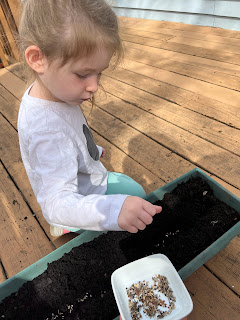
I was all too happy to turn up some dirt in our vacant deck planter and get these seeds planted, which my trusty assistant, Cecilia, took charge of happily – a little ditch for planting, a cover-up and sprinkling, and some sun and watering steadily can help them grow!

But it turns out, they may have needed to be cold-stratified? Or maybe the temps in our region and the still-cold ground will take care of that? Not sure. We’ll see. Even if they don’t grow, we can move the planter’s contents to the ground and give them another winter to see again. For now, we wait…

+ + +

Ceci took a break from
backyard trike-riding
to come finish the mulch!
I wanted to plant a tree. Well, I wanted to avoid adding too many material things to my Christmas list. And I also wanted a tree to plant. So I asked for a tree. And my family got me a tree!

It’s really cute and tiny for now, like a Charlie Brown Christmas tree. And it’s supposed to be a really good one for carbon capture and climate considerations.

But now that’s in the ground, the suspense is on. Will it grow well? Will it struggle? Did I plant it right? (I swear I read the instructions exactly.) Are we watering it enough? Are we not watering it enough? Is time, like hope, actually an illusion? We’ll see!

+ + +

And my coup de gras for this spring, I decided to step up our native plants game. I’ve done milk-jug planting for two years now, and our little native seeds have gotten nice winter jumpstarts in there! The next puzzle to solve is the low part of our yard where water pools badly after rains, to the point where the grass doesn’t grow and the ground muds out.

This year, I decided to throw down a few bucks – I ordered a pre-arranged rain garden of 32 little impeccably shipped 3-inch-potted-plants, and I followed their awesome chart to plant the garden. It’s meant to catch the rain through awesome root systems, help more with pollinators, and keep the water within our neighborhood to recharge our grounds. It was fun to dig and plant and tag and prep.

Prairie Nursery includes
an awesome two-sided guide,
laminated for the work-station,
to spacing your garden
and tracking size and bloom timing.
But then as soon as I finished, I’m looking more closely… Did I sink the plants far enough? They said full sun is needed, and even a slightly shady 6-hours-a-day spot should work – is this good enough? Should I go get fancier mulch types they talked about, even though they said dried lawn clippings work fine? Was it worth breaking my no-mow April to mulch this new garden? Are the neighborhood critters gonna destroy this? Can I find natural repellents that will keep these flowers living and growing but not hurt the animals that I’m trying to repel? Agh…

+ + +

On the whole, I feel good. I feel glad. I feel like I’m doing something with our little part-acre that is good for the earth, for the animals, for the climate. It comes from a place of practicality as well as a place of spirituality.

Yet I still have these creeping doubts. Is it a waste of money? Am I making tons of mistakes? Am I getting any better at caring for this land?

So what I come back to is this Merton maxim: I think my faithful effort to do something good is good in and of itself, and somehow pleasing to God. So I’ll try to seek and take feedback and guidance in stride, with good nature, and take my lumps when little stewardship projects go awry. Because, I hope and think and believe that, at the root of all this, is a very practical and spiritual desire to do God’s will by stewarding God’s Creation. And I know God will ultimately lead me down that right road.

Monday, April 10, 2023

Introducing my Third Story: Bigger than Ourselves

by Dan Masterton

Happy publication day, folks!

Go Your Way: Stories from Our Lives of Faith is now available on Amazon as a paperback or Kindle eBook.

My collection of Catholic fiction stories includes What There Is to be Done, Abundance, not Scarcity, and a brand new story called Bigger Than Ourselves.

This new one is a little different. While the first two stories follow a single main character for the entirety of the way, Bigger than Ourselves is actually a collection of short stories. Each chapter centers on a new character, and the story builds in layers as you go, leading up to a major confluence as their paths overlap at the end.

The setting for all of this is St. Brendan Parish. And Chapter 1 is all about getting the lay of the land. 

Here's a preview of that story -- a reading of this first chapter into the audiobook podcast:


Enjoy! Happy reading! Prayerful reading.

Monday, April 3, 2023

To Gain a Way to Pray

by Dan Masterton

(To listen to this post, click this episode from my podcast feed.)


We have a lot of ways to pray.

We have Hail Mary’s, Our Father’s, and Glory Be’s. We have rosaries and chaplets. We have Mass and Adoration and Reconciliation. We have mantras and meditations and centering prayer. We have chant and sacred music and Taize Prayer. We have the Liturgy of the Hours and monastic Psalm cycles.

Some are familiar, maybe even boring, but they bring the words when we’re not sure what to do or say.

Some are favorites, the ones we relish and look forward to doing, whether to celebrate our joy or contextualize our struggles.

Some are dreaded, valued but still intimidating or daunting, perhaps not least on a Sunday morning after a long week and late Saturday night.

Some are confusing, maybe not quite ideal for our spiritual flavors and tastes.

Some are new.

And I didn’t realize this until I was in college, developing a faith out on my own. There are ways to pray that I didn’t even realize could be prayer.

I did a lot of running in college, and by running with good friends, I found how running could be a prayer. The physical action itself could be offered up to God. The time spent outdoors on the winding trails of our campus, around lakes, under trees, along lawns and gardens, was a way to be in God’s Creation. And the conversations we carried would often take on a spiritual tone as our physical movements uniquely fueled the movements of our hearts.

I also often met friends one-on-one for lunches or dinners. Even while plates and silverware clanged, even while countless other conversations echoed around us, even as dozens of fellow students came and went beside us, something oddly transcendent would happen. The choice to have a dialogue made a special space for the spirit, which catalyzed great faith-forward friendships. It became my staple for getting to know people, and it was the way I found my best friends (and discerned that one of them could and would be my partner for life).

What’s more, I came to find that reading could be a prayer.

As a first-semester freshman, involuntarily pressed into a great books seminar, I once fell asleep on my dorm bed with Plato’s The Republic sitting open on my face. That was not prayerful.

A year later, I was home on winter break, with a clear vocation to pastoral ministry, a declared major in Theology, and a gift card to Barnes and Noble burning a hole in my pocket as I walked the aisles. I stopped in the theology section and lingered for a long time – for the first time.

My eyes were drawn to the newly released Jesus of Nazareth, a bit of spiritual reflection in which a renowned theologian adjusted his approach a bit. Benedict XVI aka Joseph Cardinal Ratzinger made the choice to downshift a few gears from full-blown academia to more accessible reflections, albeit one with more training and experience than the rest of us.

I bought it and blitzed through it faster than anything I had read for required readings in my courses. Something about the way he meditated upon the person of Christ and Jesus’ actions in the Gospel claimed me and kept me close. When the second and third volumes came out, I got those and ripped through them quickly, too. As a senior, I had a chance to take a semester-long course on his theology and reread this same book. BXVI’s clear and profound understanding of the Kingdom of God became the framework for my senior honors thesis in Theology.

But before that moment, 20 years into life, 14 years into Catholic education, I don’t think I really thought that reading could be a prayer.

And that’s kind of silly.

I think I had imagined that reading the Bible or listening to Bible passages could be a prayer especially at Mass. But could reading some other nonfiction, or even just reading a fictional narrative be a prayer, too? It was a whole new world.

It led me to CS Lewis, especially The Great Divorce and The Screwtape Letters. It led me to Shusaku Endo, who we read for my World Christianity undergrad class, and his amazing works Deep River and Silence shook me to my core in the best ways. And it eventually even pushed me to bring my spirituality and my Catholic curiosity into other really enjoyable fiction, such as the interpersonal and mental health themes of Fredrik Backman’s Anxious People or the deep-space, cosmological, and macro-ontological questions of Andy Weir’s Project Hail Mary.

For me, as someone who’s curious, as someone who wants to bring parts of me and my world into dialogue, someone who wants to identify tensions and search for resolutions and resonances, it is a deeply spiritually satisfying capacity to develop. But if it weren’t for the right moment and the right gateway to this world, I don’t know if I would ever have gotten there.

I think something has to happen at some point to bring your spirituality of prayer into the action of reading. And if Benedict XVI and Augustine and Aquinas intimidate you – heck, they still intimidate me a bit, too! – or if even the reputations of CS Lewis or Graham Greene give you pause, what about a low-key alternative? What about another author who doesn’t have their gravitas or pedigree or reputational weight?

What about me?

A few years ago, I got into fiction writing. Using some writing aids provided by NaNoWriMo (National Novel Writing Month - an annual November campaign), I worked out a fiction story, wrote it, edited it, and began to share. I repeated this process twice more. Each time, the story focuses on a Catholic person (or people) who is trying to discover God’s invitation and live it out in his or her life of faith.

The result is a collection of three right-sized stories that I’m calling Go Your Way.

The cover art is one of my Camino de Santiago shells
that I wore on my backpack while I walked the pilgrimage.

My hope and my goal is to bring spiritual reading to you. I want there to be accessible, plainly told stories that can draw you into the possibility that reading can be spiritual and can be a prayer. And rather than point you toward theological treatises or to wide-appeal self-help stuff at the big-box bookstore, I want to offer you relatable characters with relatable lives and relatable problems. I want to offer you nuance, reflection, and a grounded optimism. I can’t offer much by way of dime-store romance or shocking, thrilling, twists-and-turns drama. But I can offer you spiritual resonance and consolation, by way of Theresa, Noah, and the many folks of St. Brendan Parish.

And I think if you give it a shot, reading these stories can do some new things for you in your reading and in your prayer. With these stories in your hand, you can find a new avenue of prayer.

Go Your Way is available via Amazon as a paperback or Kindle eBook starting on Easter Monday (April 10). For more information, visit the Go Your Way page.

Happy reading! Prayerful reading!

Tuesday, January 17, 2023

The Limits of 'Let Me Know'

by Dan Masterton

Often, when I’m sending a work email to ask someone a question or trade updates on something, I’ll conclude with some version of “let me know.” There are times to be more direct and urgent, and then there’s times to move more gradually or deliberately. For the latter, I often do my bit to move the ball forward and then leave it be with the other folks for a time.

But I have to say – I generally use “let me know” more carefully than I used to use it. I try to save it for the times when it’s truly fine for things to go slow or be more passive, and to resist utilizing it when a more proactive attitude is needed.

Here’s why.

At one of the schools where I did campus ministry, my colleague and I tried to get a particular program going. A popular retreat that we offered had a reputation – rightfully earned – for being powerful for its four days but having seriously diminishing returns. Students infamously lapsed away from the things they discovered and the promises they made to themselves and others and God while on retreat.

Our goal was to hold monthly gatherings on Sundays where students could get another taste of the things they enjoyed on retreat: a small, intimate experience of liturgy; simple personal and communal prayer; and vulnerable, trustworthy faith-sharing. We only had four students at the first gathering, but we grew to drawing a dozen or two kids at each one.

One benefit to meeting on a weekend was that alumni or kids who left the school could still come. One student who led as a junior but transferred away for senior year would return to join this gathering each month. Another student who had taken leave for personal/medical reasons came, too, and it was a major way she stayed engaged with her friends.

I remember this latter student left a comment on our campus ministry Instagram when I posted a picture of our prayer wall at the end of first semester. It was just a chalkboard with space to write people’s names or special intentions for folks to see and hold up in prayer. I hadn’t carefully looked at every intention that my kids had written, but in the post, this student noticed her name had been inscribed on our board while she’d been away. She loved it.

Here's an example of what the board would look like.

She came to one of our gatherings during her leave from school, and it was heartening to see her classmates welcome her so warmly. After some individual reflection and little small-group conversations, we invited individuals to come forward and share what they had reflected on. After a few others shared, this young woman on leave came forward. Without getting into her specifics, she described a little of what she was facing and expressed her desire to stay in close touch, even while she wasn’t in the classrooms and hallways each day. Our group was small enough that day that people felt comfortable replying aloud as she finished – a few kids spoke up immediately to promise they would stay in touch, keep her in the loop. And a few said, “Let us know if you need anything.”

Now, my colleague who was leading this group with me is a religious priest, and he has a way of proceeding that I love. He is charming and disarming, for sure, but he is also intelligent, careful with his words, and not afraid of offering a direct invitation, even if it is challenging. Something about this dynamic set him into motion. And the follow-up reflection he offered sticks with me to this day.

He stood up and thanked the young woman for sharing. And then he turned his attention to the other students. I’m paraphrasing, but he said something like this: “And thank you for receiving [her] so warmly. And for offering to help her when she’s in need. But she just walked up here, and with courage, told you exactly what she needed. She wants to stay in touch. She wants you to keep her in the loop. She wants to stay connected with you. So you should not wait for her to ‘let you know.’ Don’t be passive and put this back on her. There is something clear you can do right now. When we finish up in a few moments, go over to her and share your phone number. Share your social media handles. Promise her a way and a frequency that you’ll stay in touch. Don’t wait for her to let you know – she already let you know. Now you need to respond.”

Teenagers are great at a lot of things, such as creativity and broad imagination, detecting and naming phoniness and shallowness, and building social connections, to name a few. Follow-through and reliability are often major weaknesses for many teens. And in this moment, my friend and colleague saw – I think, rightly saw and sort of predicted – a promise that was well-intentioned but all too flimsy. And he saw a promise that if left unmet could further wound a young woman already admittedly struggling with some social things. He foresaw a potential situation where she could be shoved further into sad and dark places when she had come to this gathering of her peers looking for joy and light.

I thought his words were true, firm, and challenging. And, given his poise, and his credibility with our students, they responded. Many students spoke with her one-on-one or with a little group after we finished. She left with contact info for many of those kids. And, though I would never know exactly how it unfolded, I know she did stay connected to some of them and to our school and campus ministry for the rest of the year. (I left my job and that school at that point.)

When it comes to our mental health and that of our friends and family, I think it’s helpful to make the blanket offer of help – to authentically offer a person “whatever you need.” But sometimes, I think we let courtesies and manners and automatically generated small-talk phrases crowd out intentional presence. When someone tells you what they need, hear it and heed it. Promise to do what they’re asking you to do – if you can – and then do it.

Greater honesty and awareness with mental health is helping us make strides in accompanying one another better, with greater, deeper love. Let’s make sure that when someone is vulnerable and insightful enough to tell us what they need, that we then follow through and do that, for them and with them.

Tuesday, January 10, 2023

My Little Spin with Therapy

by Dan Masterton

The steady growth of mental health awareness the last few years has been a long time coming. For example, this past week, when we saw NFL coaches reacting to a major on-field tragedy by giving their players space and grace to process, I was flabbergasted (in a good way) to see something positive that likely wouldn’t have happened even five years ago.
I have plenty of close friends and family members who have shared positive stories of seeking therapy. They’ve celebrated lowering their stress, identifying strategies for self-management, and finding a higher baseline for everyday life.

At different points over the last several years, I’ve wondered whether or not I should take the plunge. I certainly have some highs and lows to my days and weeks and months. I also feel like I manage myself well and don’t notice in myself many of the hallmarks of mental health struggles. Yet, almost like the value of physical exams for well-visits to the doctor, I imagined there could be definite good in giving it a shot.

So, after years of hemming and hawing – and ultimately deferring – in mid-2022, I enlisted an online telehealth service (I chose MDLive, which let me pay one appointment at a time for a per-use fee rather than requiring a subscription with higher appointment frequency and recurring payment). I matched with a nice middle-aged Christian gentleman in downstate Illinois. We spent the first meeting talking through lots of introductory stuff for about an hour. I wanted to focus on impatience and anger, and the way I misdirected it at my children and wife and frustrations, over pet peeves and inanity in daily life as a mostly stay-at-home parent. He worked me through these areas gently and pieced together a pretty good snapshot of my personality.

We met a second time, doubling back to many of the same stories and questions, and digging into my emotions and mindset in anecdotes I recalled to add color to my explanations. What did we find?

First, while he said he didn’t feel any of my traits lended themselves to a particular condition or diagnosis, he identified my tendencies as being closest to Obsessive Compulsive Disorder (OCD). I didn’t bristle; if anything, I felt seen! He accurately identified that I’m happiest and stablest when things go smoothly and efficiently and that I struggle most when things get messy, complicated, or mixed up.

Second, he encouraged me to study Choice Theory, which he talked me through carefully during our appointments. Essentially, Choice Theory (according to the Glasser Institute) is “based on the simple premise that every individual only has the power to control themselves and has limited power to control others.” The self-management strategy, then, is to look at a situation and ask what one can control and what is outside one’s control, and use that to remain calmer and more peaceful.

As someone with tendencies toward being a control freak, I worried a bit about what this might cause, but in practice, I found that it guides me toward a moderated approach. I find myself using the question “what can I control?” as a brain-break moment when I start to look my patience or my temper spikes; it’s the mantra I mumble or think as I step away or take a deep breath. It helps me focus better on tending to the things I can control and more easily letting go of the components beyond my control.

It also orients me toward prioritizing “connecting habits” over “disconnecting habits.” For example, trusting over nagging, and listening and support over complaining and blaming.

Here's a list of examples from Glasser.

After two appointments, we both felt pretty good about where I was. He left the door open for me to return for appointments whenever I wanted, but neither of us felt like it was imperative to continue with high frequency.

I agreed. It has been several months since I saw him, and I feel steady in rolling these positive strategies into my daily mindset. It’s nice to know I’ve established contact and have a connection with someone who can definitely help me, someone to whom I could return for further conversations. And also that I may not need to see him weekly or even monthly to find benefit for me where I am at.

All of this is to say that nothing about therapy was incompatible with my Catholic Christian faith, morals or values. On the contrary, I found that my therapist was explicitly respectful of my religious motivations and even sought to uphold those fundamentals in the way I think and act. And I felt that his advice for identifying and utilizing new mindset strategies could and would in fact improve my ability to do good, avoid evil, and build loving relationships.

My hope is that anyone who hasn’t tried therapy gives it a shot at some point. Even if you feel mentally healthy, it has the same effect as a physical exam – it’s a mental analog to checking your vital signs, examining your body and systems, and giving advice for continued physical wellness.

And if you have concerns about how your beliefs might impact how therapy will work, give it a try and see. You can use search methods to look for a Christian or Christian-conversant therapist. You can bring up your religious beliefs early in the first appointment. And you could switch therapists if you don’t find a good fit at first – many, if not most, people need to talk to a few folks before they match well with someone.

Featured Post

Having a Lucy

by Dan Masterton Every year, a group of my best friends all get together over a vacation. Inevitably, on the last night that we’re all toge...